Friday, 16 December 2016

Walking the line between accidental colour and Abstract Expressionism

Is Clare McEwan an artistic brand that accessories abstract art and just happens to 'do scarves' or is there more to this intriguing designer?  Lucinda Merriman finds out.

The essence of Clare McEwan is difficult to define – it’s like trying to pin a tail on a donkey – fun to try but hard to achieve in the dark.

Artist, photographer, designer, entrepreneur – she is all of these but you get a feeling that there’s a lot more to discover.

Playful yet determined, sociable but equally happy in her own company, Clare’s creative nature is highly tuned, sensitive to things both light and dark. Her specific seam of creativity and the paradox of an artist’s persona; seem to evoke the multiple layers that define her artwork.

Born in Dartford, Clare had an aptitude for science and thought that her future lay there until she was waylaid by the fantastic art department at Dartford Grammar School.

Inspiration appears in many guises – art teachers seem unlikely heroes but Clare will tell you otherwise: 

“Artists themselves, my teachers had contrasting characters with different areas of expertise that complemented each other perfectly. They were extremely encouraging, introducing me to Abstract Expressionism, Cubism and Minimalism and through their infectious enthusiasm gave me an independence and freedom to create bespoke products from an early age. Drawn to the abstract, I developed my drawing skills, studied composition and the formal arrangement of layer and colour. They made me realise that I could have a career as an artist.”

With supportive yet chilled out parents, Clare left school with ‘A’ Level Art and chose to do a degree at London’s Central Saint Martin’s College.  On successfully completing her foundation course, Clare opted to do a BA in Textile Design for Print.

Graduating with a First, Claire developed a firmly established style based on her independent thought and love for experimentalism and produced six huge 2m x 1.5m wall hangings in a variety of translucent fabrics including PVC mesh and crinoline for her degree show, one of which was bought by the college for their collection.

Clare said: “Textile design came naturally to me as this medium gives me flexibility to work in large format and to indulge my abstract ideas.”

On leaving and after a slight post-uni wobble, Clare moved back home to her parents and got a job with a freelance rug designer where she received an interesting commission to produce an artwork to hang in the reception of a private Bone and joint Health clinic in the Emirates Towers, Dubai. 

"I was so excited, what an amazing opportunity to showcase my work on an International stage.  My largest artwork yet, I created a 6m x 2m textile hanging using similar techniques to those used in my degree show. My abstract imagery likened broken glass, while the back-lighting activated the layers, created an interesting 2-D effect."

Clearly a 'rolling stone' Clare was keen to experience as much of life as she could over the next few years - moving back to London and selling her art on Saturday morning at the Ritzy Cinema in Brixton, being selected for an Art's Council Residency Digital Artist Placement at Waddesdon Church of England School in Buckinghamshire, then moving to Brighton to work part-time for the council while setting up a print studio and providing creative workshops at a former coach works along with other artists and performers. 

By 2011, hitting 30 and brimming with creative ideas, Clare felt the time was right to start her own business and by trial and error began designing silk crepe de chine scarves from her own original experimental artwork under the C F McEwan label.  


Clare's creative inspiration often starts with a walk and her camera and she describes the process in her Podcast '10,000 steps towards my colour palette'.

"Walking is the perfect way to collect new colour whilst boosting my mental brightness, inspiration and the motivation to get started.  I'm looking for five elements while on the move - Accidental colour, Material combinations, Light and shadow and Contrast." 

You might try to describe this technique as the trendy new meditation of ‘Mindfulness’ but I’m not sure that this is Clare’s style – it’s a little too self-conscious and forced. As Clare immerses herself into the space and her surroundings I imagine she’s an awe-inspired Dorothy stepping into Oz for the first time, what we see as mono, she sees as Technicolor. 

Clare explains:  "I collect accidental colour - unexpected new colours taken from urban or natural landscapes. Influenced by artists Eva Hesse, William Eggleston and William Christenberry, I look out for interesting material combinations that have beautiful, sculptural and textural qualities and an ephemeral instant - a brief experience or moment in time captured and translated."  

"I observe how a structure imposes itself in a space depending on the quality of light and look not only for the contrast in light but also for contrasting materials and textures. I enjoy finding infinite ways of photographing through layers as this is central to my whole practise and provides the tools to combine all my imagery, inspiring  me to create smaller and lighter objects back in the studio." 


Drawing, printmaking, hand stitching and simple marking are combined to create abstract and atmospheric imagery, with irregular shaped objects and surfaces being formed using paper, fabric and plastic.  Clare then photographs these textiles, objects and surfaces using a range of light sources and filters, exploring shadow, reflection and edge. The finished images are printed onto lightweight 100% silk crepe de chine squares (125cm x 125cm) creating beautiful abstract scarves sold in a range of boutiques and galleries across the UK and the USA. 

And what of the future, has this restless spirit found its true vocation and is she content with her current success? 

"I am very lucky as I love what I'm doing and I'm proud of my achievements to date.  It meant a lot to be one of four selected artists to create contemporary artworks for Dartford in 2016 and I've just launched my autumn/winter 2016 ‘The Cut-Out’ inspired collection and it’s already selling in well. 

I do think that I am creatively restless though - I’m keen to develop collaborations with other artists and designers and in the immediate future I’m taking some time off to travel.” 

Bearing in mind what Clare has achieved; one cannot doubt that whatever she does will continue to involve movement and her fascinating multi-tiered view of life.

For more information, visit Clare's website at www.cfmcewan.com


Monday, 14 November 2016

Article published in Dorset Life


To read article, please click here

Dorset Life - The Dorset magazine is an independently owned county magazine. Not part of a national publishing group Dorset Life is produced in Wareham by a small, dedicated team, all of whom live and work in Dorset.


Guest post on Selvedge Blog

I've just started helping out the Textile Society as their Press Officer and in this capacity, I've written a review of their London Antique Textile event, which has just been published on the Selvedge Blog.

Established in 1982 as an educational charity, the Textile Society raises money through its London and Manchester Antique Textile Fairs to help fund the Society's awards and bursaries.

Click here for more information about the Antique Textile event in April.

Click here to read my guest post for the Selvedge Blog.

Selvedge is a bi-monthly publication for interior textile and fashion designers.


Thursday, 13 October 2016

Materials Matter

A review of the unique London Antique Textile Fair, Sunday 2nd October 2016 by Lucinda Merriman.

Stepping off a bustling King’s Road into Chelsea’s Victorian Town Hall and The Textile Society’s London Antique Textile Fair is like entering an Aladdin’s Cave – cool and calming and once your eyes have adjusted to the dazzle of the display; the outside world recedes for a few hours while you immerse yourself in everything material.

Threading your way between the multitude of stands bursting at the seams with fascinating fabrics in every form from all around The World, your senses are assailed with colour, form and texture – certainly a system is needed to make sure that nothing is left out or forgotten. 

For those ‘in the know’ and serious textile collectors, this show is simply one you can’t afford to miss – where else would you find such a diverse collection of fabric from the 18th Century through to the 1970’s, pictorial embroidery, hats, preposterous Indonesian headdresses, shawls, exquisite vintage clothing, rugs, lovingly made quilts, bags, ribbons and fans? The choice is breathtaking!

Sue Richardson's stand
It’s not just the wide array of exhibitors that seduces but the experience and passion that feels palpable around the room - dealers don’t just sell but also share their knowledge, as there’s usually a back-story or history to their pieces.

Sue Richardson from gallery 196 explains: “I’ve been going to India for 30 years. Originally I was sent over as a weave designer and became interested and started to buy beautiful old textiles that I could afford. Now I sell vintage textiles from Gujarat in India, Syria, Pakistan and Peru. People there don't have very much and can't afford expensive fabrics, so they tend to use whatever comes to hand - thread-bare saris, different coloured threads - there's an amazing amount of creativity and lack of inhibition, which creates a freedom to lovingly create beautiful objects."

But it’s Liz Evans from repropattern who sells mid-Century British textiles from the 1950 – 1970’s who most succinctly sums up a textile dealers take on things: “We are the warp and weft of life.”


Liz Evan's stand
Established in 1982 as an educational charity, The Textile Society raises money through this event and their Manchester Fair in April to help fund the Society’s awards and bursaries for students, museums, archives, historians, PhD candidates, craft workers, designers, curators and conservators.

Dr Brenda King, Chair of The Textile Society for 7 years concisely distills the Society’s work: “Supporting students through our bursary awards is extremely important to us, the money we make from this and the Manchester event helps us support the future through the past.”

Centre stage, fittingly raised above the stallholders, were some of this year’s bursary award winners and Bath Spa University graduate Charlotte Street who took The Lucienne Day Award for innovative interior textiles with her stunning trompe-l'oeil imagery. 


Lucienne Day award winner Charlotte Street
A shell-shocked but delighted Charlotte told me: “I was amazed to receive this completely unexpected award – it’s wonderful to receive this recognition of a job well done, it means a lot to me that people like it and the award will open doors for this collection and my future.” 

There were 7 bursary student winners: Lorna Jewitt, Anna Duthie, Sally Cooke, Antonio Castro, Katy Welsh, Alice Richardson-Payne and Jemma Pratt.

Lorna Jewitt from the Leeds College of Art received a post-graduate student award for her artworks inspired by her part-time work cataloguing at the Sunny Bank Mills’ Archive in West Yorkshire. Central to her theme seems to be the humble paperclip and Lorna explains why:

“Through cleaning and cataloguing cards, we remove and throw away hundreds of paperclips and other detritus, which made me wonder about the person who originally clipped them onto the card and how we decide which items are preserved while others are being brushed away. I wanted to make a connection or memory to that person and place – to try and capture that ephemeral moment. This award is very exciting, surprising and lovely and will help me with the material costs for my final M.A. show.”

Whatever you were looking for, this show was sure to have it and more besides - amateur or professional, student or designer - there is something for everyone.  

With business brisk and collectors happy; there’s sure to be many more shows to come, but before that next year’s Antique Textile Fair in Manchester on Sunday 30th April is set to be a very special event as it celebrates its 25th Anniversary while coinciding with the Centenary of Lucienne Day’s birth who was the Society’s first president and created the prestigious Lucienne Day Award.

The Textile Society has lots of exciting things planned to celebrate these two momentous occasions in collaboration with Lucienne’s daughter Paula Day and the Robin and Lucienne Day Foundation. For more information, visit http://www.textilesociety.org.uk/events/ and http://www.textilesociety.org.uk/

Tuesday, 27 September 2016

29th ‘Art for Youth London’ affordable art fair held at the Mall Galleries raises funds and profile of 105-year old charity.

Steel Sketch No.2 in steel and wood by Guy Haddon-Grant.
An annual affordable exhibition, ‘Art for Youth London’ not only acts as an important showcase for budding and established contemporary artists but raises substantial funds for national charity UK Youth.

Established in 1911, UK Youth is one of the best kept secrets in the charity sector taking a low profile while working tirelessly to help over 700,000 young people every year to take control of their lives.

This year’s 29th event on Wednesday 14th September and Thursday 15th September 2016, buzzed with people who had come to view over 1,000 artworks from around 130 artists.  The diversity and quality of work ranging from paintings and ceramics through to sculpture and jewellery was astounding and the range of prices, £200 - £5,000 meant that there’s something for everyone.

'Travelling Light' in bronze and steel by Arabella Brooke.
Matt Lent, Director of Partnerships & Policy was at the event representing the charity and said: “’Art for Youth London’ is our biggest fund raiser of the year and through it we have incredibly raised over
2 million pounds since it began; without it we couldn’t offer the help and support that we do.”

Diana Brooks committee member and founder of the event presented a prize sponsored by The Wates Foundation for the best artist aged under 35 years.  This year The Wates Foundation Diana Brooks Prize went to Jake Barker, who's monochrome projects are centred around human welfare or wildlife conservation.

Diana explained why she had chosen Jake: "I can't describe how much it means to help a young artist to get established,  When I first set up this event 29 years ago it was all about helping young artists as well as raising money for the charity.  This year I've chosen an incredibly talented young artist called Jake Barker who is only 20 years of age, is self-taught with no formal training and this money (£1,000) will help him on his way from here on."

Artworks by award winner Jake Barker.
For more information about 'Art for Youth London' visit http://www.artforyouth.com/ 

To donate or find out more about UK Youth visit http://www.ukyouth.org/ and The Wates Foundation at http://www.watesfoundation.org.uk/


Friday, 26 August 2016

Banks saved

Since May 2016, 600 banks have closed in the UK; Lucinda Merriman finds out how our banks are being saved and deposited back into the community.

Ladies & Gentlemen cocktail bar
Take a walk down the high street in many of our smaller towns or cities and you will see that the buildings have changed enormously over the years. Once thriving communities, they no longer offer a range of different shops or businesses - every other shop is a charity, fast food or a coffee chain. 

As shops, factories and banks close, people find less and less reasons to visit these soulless places, investment is withdrawn as sales move on line and out of the city centres to large sterile retail parks.

It’s encouraging to see therefore that at least some of our historic buildings are being saved and regenerated.  Underground public loos in London are being turned in to novelty cocktail bars, traditional red phone boxes in Birmingham are now trendy micro cafes and by 2022 the London Museum will be relocating to its new home in the renovated and adapted buildings of the western end of Smithfield’s Market. 

While the Landmark Trust is busy saving the more exciting end of the spectrum of abandoned or dilapidated buildings such as castles, forts or follies, it is left to consortiums or private investors to save the more mundane structures.

Banks are closing all over the country at an alarming rate; in May this year Rebecca Wearn, Business Reporter for BBC News, reported that: "More than 600 bank branches have closed across Britain over the past year."  The data included information from Lloyds, Royal Bank of Scotland, HSBC, Santander, Barclays and the Co-operative and it seems that rural communities, especially in remote parts of Wales, Scotland and South-West England are most effected.

In the 19th Century, banks were built in the most opulent, grandiose fashion as displays of wealth aimed to convince potential customers to invest in these establishments.  Built by leading architects of the time, scores are listed, having historical significance, and frequently they have an interesting story to tell.

The Old Bank of England restaurant and pub
Built in 1888 on the site of two former 16th Century taverns in Fleet Street, London, the Law Court’s branch of The Bank of England traded for 87 years. Lovingly restored in 1994 by London brewers Fuller, Smith and Turners, The Old Bank of England is now a restaurant and pub. 

It’s lavish interiors and original features make it a stylish venue and it’s reputed to have some infamous historical neighbours. This site is said to have been once sandwiched between Sweeney Todd’s barber’s and Mrs. Lovett’s pie shop and it was in the tunnels and vaults below the building that the victims were butchered before becoming pies. An interesting claim, given Sweeney Todd and his accomplice were fictional but I would like think if there is any grain of truth to this well-known urban myth, that it happened either side of The Old Bank of England.

The Gotham Hotel
‘King of King Street’ the impossibly impressive former Midland Bank headquarters, 100 King Street, Manchester was designed in 1928 by Edwin Lutyens and decorated by local sculptor John Aston Floyd in a classic Art Deco cenotaph style.  

Taking 7 years to complete, this Manchurian ‘skyscraper’ traded as a bank until 2008 when it was acquired by a developer and restored by Aura Conservation. Christened ‘The Gotham’, in a playful nod to the iconic New York skyline, this Grade 2 listed building is now an elegant 5-star hotel with a Jamie Oliver restaurant in the main banking hall.

Last of our interesting trio is an ex-Lloyds bank head office in Bristol. Built in 1856 by architect William Bruce Gingell, inspired by Sansovino's Library in the Piazzetta, Venice, considered to be one of the major architectural works of the 16th Century.  Long considered as an iconic historical building in Bristol, the bank has been converted into a prestigious luxury hotel - Bristol Harbour Hotel which opens in October this year. 


The Bristol Harbour Hotel
Its spa is cleverly located in the vast bank vaults and its entertaining to ponder how once these vaults were where people saved money, when now they are where they spend large amounts of cash.

It’s heartening to see that these fine buildings are being saved but it seems ironic that people now enjoy spending time in these formerly austere and institutionalised spaces, where only a Bank Manager or robber would happily have spent time.

Their rejuvenation brings jobs and prosperity back into these areas but we should spare a thought for the former bank’s customers.  The decline of these financial institutions is a contentious subject as a minority of people struggle to come to terms with modern banking methods and the lack of face-to-face interaction. 

It may also be that many local residents don’t have the resources to enjoy the 5-star exclusive spaces that the developers are creating, which theoretically causes further fragmentation of these communities. It is certainly a discussion that will gather interest!

Wednesday, 17 August 2016

Fair pensions for all women!

Eager, hopeful faces shine out from this school photograph taken of pupils aged between 8 – 9 at Havelock Junior School, Desborough in the early 60’s. Carefree and innocent, these children wouldn’t have known what a pension was, much less considered the day when they would need to draw one.

All of the girls highlighted on picture are now in their sixties, still living locally, in and around the area they went to school. They have families and led busy lives working and bringing up their children, looking forward to a time when they can retire and enjoy their grandchildren.

However, government policy changes to both state retirement age and how the pension is paid have resulted in serious and upsetting repercussions for many of the women shown in the photograph. 

Women's state pension age is now set to increase to 65 by 2018 and 66 by 2020, instead of the previously proposed 2026.  By increasing these timescales, the government has reneged on its promises and slashed the time potential pensioners have to prepare for this life changing event.

If you are a women born on or after April 1953, not only will you have to work longer (up to 4 years 3 months in some cases) to claim your pension but if you were born before April, 1953; you will also lose out on the new ‘Single-tier’ State Pension, which began this year in April. Only women born on or after April 6th, 1953 will be able to collect the enhanced state pension under the new system. The hope is that these new proposals will bring to an end the poor State pension deal that most women get who have stayed at home bringing up their children or worked in poorly paid jobs.

However, it is estimated that 80,000 women will miss out on the proposed £144 a week improved pension receiving a basic state pension of just £107.45 a week – a loss of £36.55 per week for the rest of their lives. 

And consider also that by having to work longer, the women in this photograph will also be missing up to 2 years and 4 months worth of pension payments that women born before then will automatically receive.  So the loss from the first and last lady to retire could equate to a loss of over £16,000. 

Kay Wykes, née Tebbutt is very upset and said: “Jean Franklin who is just one month younger than me and started getting her pension in July this year but I have to wait another 8 months for mine. Pauline and Kay have to wait until November 2017 for theirs, it really isn’t fair.”

Married to Ken with two children, Heather Ward, née Goodman has lived in Rothwell all her life. Leaving school at 16, Heather took a secretarial course and was employed by Rigid Containers before joining local footwear manufacturers Groococks in 1973, where she has been ever since. After working for nearly 43 years, with only short breaks to bring up her two children, Heather is understandably keen to retire but was born in June 1953 and in consequence has to work an extra 3 years, 9 months before she finally does.

“I’m so disappointed and feel very let down that hard working women aren’t rewarded in this country.  I have worked all my life, brought up a family and contributing to the community.  I really don’t think it’s a lot to ask for the government to stick to their side of the bargain and pay my pension when they should. Instead I now have to wait almost four years to receive my pension.”

Two of her friends also in the picture, Pauline Panter, née Wiltshire and Kay Wykes, née Tebbutt both born in August 1953 are also concerned and disappointed as they also have been hit by the new retirement age and will not receive their pension until November 2017; the irony being that some of the boys in the photograph will be receiving their pension before they are.  

If you were to calculate, over a working lifetime, the amount a woman loses through timeout having children and now through pensions, it would add up to a sizeable amount. And don't forget that they are already subject to gender pay discrimination where men earn considerably more and even today’s pay statistics show a pay discrepancy between men and women of around 19.2%*, when full and part time employees are combined. This really is a national disgrace for these hard working women and thousands like them who throughout life have worked hard, brought up families and added to their communities. 
Over to you Damien Gere, Secretary of State for Work and Pensions! 

*Figure taken from the Equal Pay Portal.


Read Dr. Ros Altmann views on this debate..

Join WASPI (Women Against State Pension Inequality).

Please like, share and follow ('Follow' button top right hand corner). Thanks x

Monday, 1 August 2016

The Help

Adapted from a best-selling book that took its author Kathryn Stockett 5 years to write, ‘The Help’ was directed by Tate Taylor who along with Kathryn was born in Jackson and attended the same pre-school.

‘The Help’ is set in 1962 in the middle of the Mississippi Civil Rights Movement, 7 years after Rosa Parks made history in Montgomery and 6 years before Martin Luther King was to be assassinated.

The film tells the story of African-American maids working for white families in Jackson, Mississippi and how a privileged white woman, Eugenia ‘Skeeter’ Phelan (Emma Stone) returning from college, aspiring to be a writer, takes up their cause.

‘The Help’ has a convincing cast who fill the screen with interesting, all be it stereotypical, strong women. Octavia Spencer won the Academy Award for the 'Best Actress in a Supporting Role' as sassy Minny Jackson who saves Celia Foote (Jessica Chastain), the good-hearted floozy in an entertaining 'Gone with the Wind' pastiche.

It’s a shame the men are so 2-dimensional, given in the 60s women were still suffering prejudice themselves in education and the workplace.  And it’s also interesting to note that there is only one real villain – Hilly Holbrook, played with great pantomime gusto by Bryce Dallas Howard; when in reality she would be in the majority.

It's a commendable attempt to present a sanitised version of this emotive subject but for all its uncomfortable moments of segregated loos and complete disregard for feelings; it never delivers the brooding menace of real violence against African-Americans that festered in the South at this time.

For all its faults, it's worth watching - this elevated 'chick flick' is superficially uplifting - women triumph, baddies get what they deserve and good prevails.


Wednesday, 27 July 2016

It's all Greek to me!


Can the ancient Greek sculptors teach us about contemporary photography and styles? Lucinda Merriman meets photographer Hannah Chambers to find out why she thinks that they can.

Hannah Chambers, 22, a little shy but determined, graduated from Portsmouth University in 2015 with a 2:1 in Interior Architecture and Design.

Interested in architecture and history from an early age, Hannah explains: “I’ve always been fascinated by classical architecture – Roman and Greek grandeur – soaring Corinthian columns and the drama and beauty of the Greek sculptures.  I love historical buildings that we don’t seem to be able to build now and I’m really interested in their restoration and conservation. It’s interesting to see contemporary architects designing new additions that sympathetically enhance, while not changing the integrity of the building. 

"I love what David Closes did with the 18th century Convent de Sant Francesc in Spain, his fantastic contempoarary auditorium fits perfectly with the original building." 

“I also admired Zahra Hadid, I respected her confidence, determination and style.  Her architecture is very innovative, I like her fluidity and sense of movement. Her designs enhance their surroundings and will be design classics of the future.”

After graduating, Hannah quickly got a job at an exhibition designers and has now moved on to be a 3-D designer conceptual and 2-D shop fitting designer.

Hannah is also a keen photographer, “My dad was always snapping shots which looks effortless but were really good, he taught me a great deal but it was only after doing my degree that my eyes were really opened to the art of photography.  

Ground breaking photographers like Richard Avedon with his series of documentary style shots of ordinary people ‘In the American West’ and Henry Cartier Bresson’s street photography really interests and excites me.  I’m intrigued with his idea of the ‘decisive moment’ when a photographer chooses the exact moment to capture the shot.”

Hannah would like to turn professional at some stage in her career and having had some experience in wedding photography, would like to do more. And it seems that her early appreciation of Greek sculpture is something she thinks can be applied to the photographer’s craft.

“Greek sculpture captured the human form in a way that was new – they considered proportions and poise and presented an idealised perfection of the human body. As a wedding photographer, you are asked to represent the couple at their peak – this is their optimum moment – their crowning glory - they must look like Gods! I want to capture that ‘decisive moment’ for them to keep always.”

“I see wedding photography as a merger of old and new – there’s a long tradition that has to be upheld which dictates which shots need to be taken but I always aim to introduce a new twist or angle that is unexpected. To me it's all about that true moment when someone relaxes and their true personality shines – it’s unguarded, spontaneous and above all real.”

As Zahra Hadid said, “There are 360 degrees, so why stick to one?”


To see more of Hannah's pics, please click here.


Tuesday, 26 July 2016

Gin to make you grin


From cheap Mother’s Ruin to £2,000 a bottle for Watenshi, the World’s most expensive; gin has been part of our culture for over 400 years. Lucinda Merriman visits Warner Edwards, craft distillers in Northamptonshire to find out why ‘boutique brewing’ is such big business.

I had my first G & T in a hotel lounge in Haywards Heath at the age of 40 and being a firm favourite ever since, when an invitation arrived for a tour of our local craft distillery Warner Edwards at Falls Farm in Harrington, Northamptonshire; I was keen to take up the kind offer.

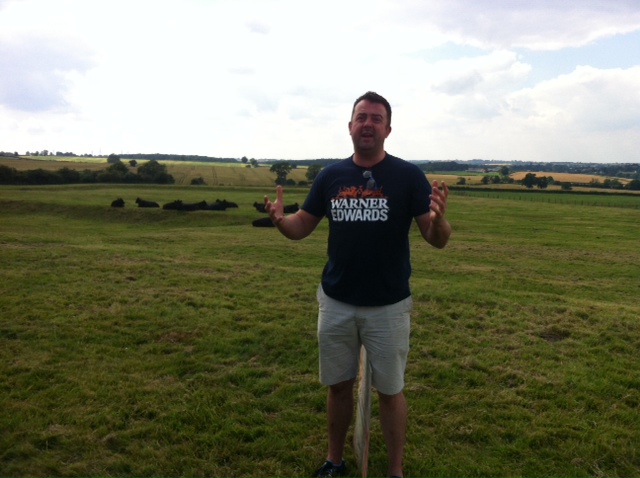
With instructions to meet at the Tollemache Arms pub in Harrington at 2:45pm, ready for the tour at 3:00pm, the majority of the party decided to ignore this simple request arriving in dribs and drabs until 3.15pm. At last however, we were off following partner Tom Warner out through the pub’s front door and off along the road and into a field.

Being a ‘country girl’ and hearing that the distillery was on a farm, I decided to wear suitable footwear but was amused to see a number of our group were clad in high heels unsuitable for a hike through an undulating grass field complete with cows and their pats.

After a hesitant start – people hanging on to one another for support, a few dissenting murmurs about whether the cows were man-eaters, we walked along the top of Falls field with grassy terraces to our left and a stunning view down the valley to our right.  Tom stopped us halfway and began his tour with the history of the farm and the location of three natural springs, used to ‘finish’ their gins.

I was fascinated to learn that we were standing on the remains of huge terraces of a monumental post-medieval garden, which at one time led down to a house and a network of fishponds at the bottom of the valley. There’s not much to see now but taking into account the stunning view and scale of the garden, this must have been a truly amazing sight in it’s heyday.

Making our way into Falls farmyard, we paused to admire the exterior of the 200-year old converted distilling barn (formerly used as a ‘hospital’ for ailing livestock), before entering and placing our G & T orders – Dry, Elderflower or Rhubarb.  

I opted for the elderflower which had a pleasing blueish hue and tasted light and refreshing – I can’t claim to say that I tasted all the subtle botanicals, which included both dried and fresh elderflower but it was lovely on this hot July afternoon.

Standing in the newly planted ‘botanical garden’ sipping our drinks, Tom enthusiastically explained how he had built it as an homage to his mother and as a source of inspiration for his next gin flavour. Currently they are experimenting with Lemon Balm and hope to launch with this in September.

G & T’s polished off and ‘glowing’ we were soon back in the barn being introduced to ‘Curiosity’ the copperpot still custom built in Germany by Arnold Holstein. Tom explained the gin making process, which is clearly a labour of love and very lucrative given gin sales in the UK are estimated to reach £1 billion this year.

The tour finished with a tasting of four gins: Dry, Elderflower, Rhubarb and Sloe.  Tasting neat gin is in my opinion not the best way to appreciate them but I bravely pushed on and ended up buying both the Dry and the Rhubarb before leaving with a big gin-grin on my face. Cheers!

I took part in a corporate tour with VertoUK, Creative Web & Graphic Design.
Normal tours are held every Wednesday at 7.00pm (minimum of 10 people). 
Tour tickets: £15 per person with £5 redeemable in the distillery shop and a G & T upon arrival.
To make a booking call 01536 710623 or email tours@warneredwards.com

Thursday, 14 July 2016

Beauty or beast?

Appearances can sometimes be deceiving: Lucinda Merriman meets conceptual Illustrator Eleanor Marriott, one of the new wave video game designers, to find out how the horror genre can be an empowering, feminist force.

Meeting Eleanor May Marriott for the first time is certainly a very interesting experience as she fills the room with her off beat vivacious personality. At 21, she’s a cross between Scarlet Johannsson and Sarah Millican – stunningly attractive, with a curious dress sense and a witty self-effacing sense of humour.

Recently graduated in Graphic Communication and Illustration from Loughborough University, you could quickly dismiss her as being like many middle class design graduates – privileged, predictable, blond and dipsey; but appearances can be deceiving, as Ellie is far from what you would expect, having a fascination with the darker side of life.

Adopted as a baby by a farming family in Leicestershire, Ellie was brought up knowing about her biological parents and their reasons for giving her up. "Being adopted doesn’t have much to do with who I am but growing up on a farm has helped me put nature vs nurture in some sort of prospective, as I do believe that rearing an animal or child is the most important and difficult part of the process."

And Ellie suggests that it was this early exposure to the realities of raising livestock that gave her an upbeat and realistic outlook that embraces the horror film and game genres that she so loves.

"I think I'm desensitised to scary things because of watching it for real from an early age, seeing a calf born, sending animals to market - there's no sugar coating on a farm."

Ellie started gaming early having her first XBOX 360 and Halo (science fiction shooter game) at only 7 years old. "I’ve always loved to escape through games and I definitely have a wanderlust and rebellious streak. "I’m fascinated by the idea of inter-dimensional travel, other worlds and paranormal experiences."

It might seem that Ellie wants to escape reality but she refutes this: "I am perfectly happy with who I am now. Everyone from an early age is always asking - who do you want to be, what are you going to do? There’s a lot of pressure to conform and be a success - I have always been a little alternative and want to do it my way; I’m at that age where the future is a big mystery."

Ellie is looking for work as a conceptual 2-D Designer and Illustrator and showed her potential for illustration at her university’s end of year Arts Degree Show where she exhibited a mixture of monsters and a video game concept called 'Presence' about demonic possession.

One disgustingly, disturbing monster featured in her portfolio, Ellie explains: "This grotesque, multi-limbed monster is a combination of  'popular' phobias - spiders, deformity, death and decay - this apparition creates a tension with the viewer which the monster mirrors back through the tension in its skin,  It looks uncomfortable, incomplete - in some ways I think it's a metaphor for being a woman."

This seems a pretty bleak interpretation of womanhood but Ellie seems unconcerned - as it she doesn't really take herself or her creations too seriously, cultivating a dark sense of humour, yet thoughtfulness in her work which aims to shock: "I want to subtly wrong-foot people, to create a brooding atmosphere that knocks you off balance - you know when you are walking and suddenly take an invisible step down - it's unnerving."

Ellie explains her creative process: "I draw constantly, sometimes for 5 hours at a time, where spur of the moment ideas pop out of my head straight onto the page.  I often listen to video game sound tracks to help focus my mind, (interestingly they have been shown to help concentration) and become fully immersed to the extent that I must be on autopilot."

Talking about who influences her work, she says: "My mother bought me a book of architectural sketches by John Ruskin which I found very inspirational.  I love his use of line and the detail to his drawings.  There's a great atmosphere of Victorian Gothic melodrama, which I find especially appealing." 

Ellie also takes inspiration from video game artists such as Joe Madureira who created 'Darksiders', an action role playing, hack 'n' slash video game developed by Vigil Games and published by THQ.
Ellie enthuses: "I love the amazing monsters and demons Joe creates and the pacy story line, he has a great eye for composition and form and his environments are just gorgeous." 

So where will this take Ellie in the future and what does she think she can bring to this very masculine genre?  "I hope being female in an industry where the key influencers are men but where increasingly more women are playing and enjoying these type of games will help me create a more accurate representation of what today's women aspires to be.  We need more strong, non-sexualised female leads that will help enforce the idea that women are not victims but can kick butt too!"  

Ellie is certainly of this mould - she's a contradiction - appealing, thought provoking and often quite disturbing but nobody's fool - beauty and beast combined!


Monday, 4 July 2016

Fårö, Fårö away

As a shy 18 year old living in a small Northamptonshire village, who's only experience of 'Abroad' was a weekly glimpse of foreign climes in the company of Cliff Michelmore and a swoon of Hollywood films full of glamorous people, leading fascinating lives in faraway places; I was keen to check-in to this exotic thing called travel and in the summer of '82 my chance to step out into the big beyond fell at my feet in the form of an invitation to stay with a family in Sweden.

Frenzied packing ensued, fond farewells and an excited but extremely nervous teenage arrived in Stockholm.

Meet Henrik (dad - businessman, inclined to road rage), Christina (mum - English teacher who opened my eyes to Apartheid), Martin (big brother - soon to leave for his National Service), Anna (enthusiastic 16 year old who was my 'exchange') and Rufino (scruffy black terrier with a penchant for hedgehogs).

I was ready to be romanced and quite prepared to fall in love with everything and everyone - this was far, far away from my provincial life - I had escaped onto a film set with me as the leading lady!

My opening scene was spent discovering Stockholm - the stunning 13th century Gamla Stan (Old Town), the gargantuan Royal Palace, the 18th century Drottingholm Court Theatre and the Grona Lund amusement park.

While I would like to say that I fully appreciated the diverse culture, sublime architecture and watery beauty of the setting: it was my first experience of a fun park which gave me the biggest buzz!

Without a copy of the script, nothing prepared me for the second week however, spent at the family's summerhouse on Faro.

Taking a car ferry to Visby on Gotland, a drive North to Farosund and another ferry to Faro, one could see why this small 18km long Baltic island is called the Traveller's Island.

Driving off the car ferry we were stopped by the military police as Faro at that time had a strategic military installation and was strictly off-limits to foreigners.  I was rather nervous when my 'special papers' were presented to the officer, who on quickly scanning them, waved us through.
  
We drove through the flat, scrubby landscape with huge Norfolkesque skies to arrive at their white wooden summerhouse surrounded by a beautiful wildflower meadow with a sprinkling of fir trees.

The weather was hot and we walked through flower-flexed pastures, picking huge mushrooms, rode bikes through cool forests and explored the rocky beaches to the West with their ancient Ice Age Monoliths known as Rauks patrolled by the military police and the sandy beaches favoured by nudists to the East of the island.

I was enchanted by this idyll and it seemed fitting that Ingmar Bergman also had a house on the island where I loved every minute of the beauty, mystery and allure - a heady mix for an impressionable teenager!

I was a real traveller and my adventure had just begun!